Christ Church

  • Our Church
  • Get Involved
  • Resources
  • Worship With Us
  • Give
  • Email
  • Facebook
  • Twitter

Expositional

Elect Exiles and Salvation Inheritance

Christ Church on January 7, 2018

https://www.christkirk.com/wp-content/uploads/2018/01/2089.mp3

Podcast: Play in new window | Download

God’s Chosen Exiles (vs. 1-2)

Peter addresses this letter to the elect, “eklektós,” the chosen ones. Most translations bump the word “eklektos” to verse two, but it’s the first word after Peter’s introduction, “Peter an apostle of Jesus Christ, to the elect…” The word “elect” was used in the Old Testament to refer to Israel, “For you are a holy people to the LORD your God; the LORD your God has elected you to be a people for Himself, a special treasure above all the peoples on the face of the earth” (Dt. 7:6). Peter echoes this in 1 Peter 2:9. When Peter addresses this letter to the elect, he is not talking about individual persons, but to God’s special people, the new Israel.

But God’s elect––the known, sanctified, blood-sprinkled and obedient people, are pilgrims scattered across the world. The word dispersion means scattering like the scattering of seed and was used in the Old Testament to describe the result for breaking the covenant (Dt. 28:25). Now God’s chosen people are pilgrims who have been scattered in Pontus, Galatia, Cappadocia, Asia, and Bithynia––the Roman provinces that make up the region called Asia Minor or modern day Turkey. Peter views this not as a curse but a blessing and cause for rejoicing.

A Psalm of Praise (vs. 3)

Peter starts his letter in worship. He begins with a psalm of praise, “Blessed be the God and Father of our Lord Jesus Christ!” There’s not a command to do something, but the acknowledgment and praise for what God has done for you.

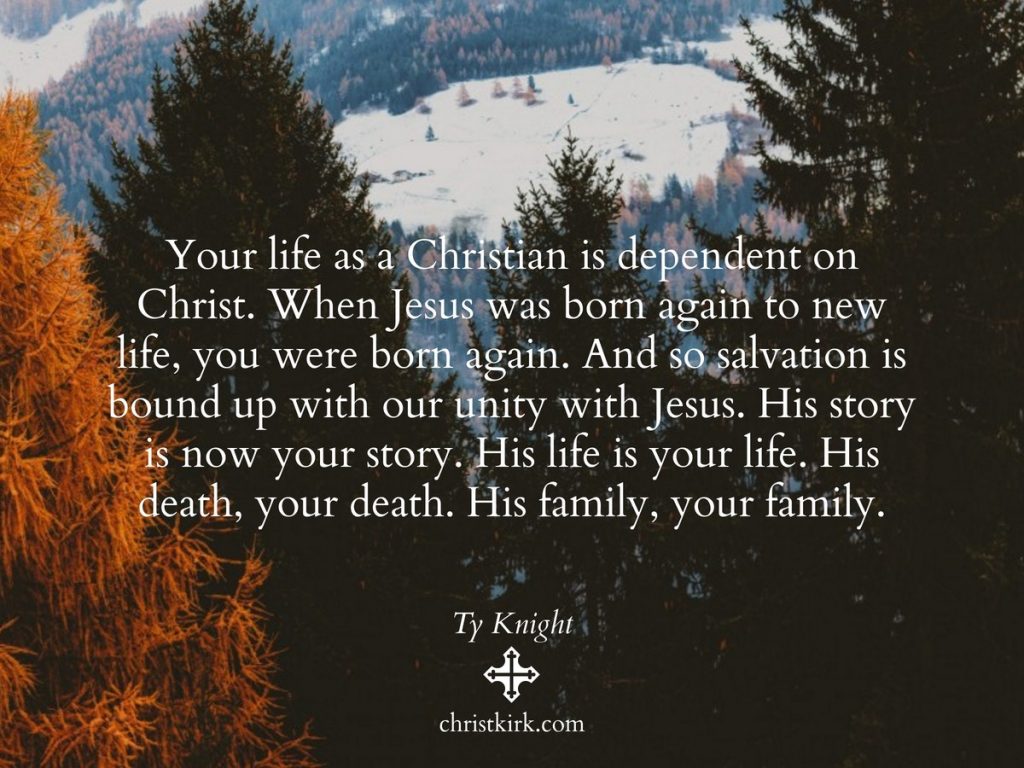
The theme for this praise is the salvation inheritance that’s been brought by the abundant mercy of the Father, through the resurrection of Jesus, and revealed by the Holy Spirit. You were dead in your sins and born as children of wrath, but now because of the Father’s mercy, you are born again to a living hope, a hope of life. And Peter specifically says this happens through the resurrection of Jesus Christ from the dead. Your life as a Christian is dependent on Christ. When Jesus was born again to new life, you were born again. And so salvation is bound up with our unity with Jesus. His story is now your story. His life is your life. His death, your death. His family, your family.

Incorruptible, Undefiled, Unfading Inheritance (vs 4-5)

And what comes in a family? An inheritance from your Father. Salvation is life in Christ. And because we share in Christ’s life, we also share in Christ’s inheritance (Rom. 8:15-17). And no one will mess with Christ’s inheritance which is incorruptible, undefiled, unfading, reserved in heaven for you (vs. 4).

Your inheritance is kept secure in heaven, and you are kept secure in the world by the power of God (vs. 5). The word “kept” means guarded, protected by a military garrison. God is the sentinel in the citadel turrets guarding your life. The Father who knew you before time began, who caused you to be born into his family, who prepares your inheritance, will guard and kept you until you come to Him.

Joyous Salvation (vs. 6-9)

“In this you greatly rejoice, though now for a little while, if need be, you have been grieved by various trials.” You greatly rejoice even when you are being grieved. Can these emotions of joy and grief, these reactions occur at the same time? (Jm. 1:2)

One of the reasons you can have joy in the pain is because you know the the trials are from the Father and He has a purpose––“so that the genuineness of your faith, being much more precious than gold that perishes, though it is tested by fire, may be found to praise, honor, and glory at the revelation of Jesus Christ.” You don’t throw a lump of gold into a fire because you think it’s worthless. Fire is applied to reveal the gold’s value and make it more valuable. But the process of purification is non-too pleasant for the lump of gold, and so love Jesus, believe in Jesus, rejoice with joy inexpressible and full of glory. God regards your faith and its fire-tested purity as more valuable than gold, more valuable than an easy, comfortable life. Your faith will gleam to the honor, praise, and glory of Jesus Christ.

The Search for Salvation (vs. 10-12)

In these last verses Peter wants his readers to appreciate how valuable the gift is that they hold. The prophets in the Old Testament “searched carefully and inquired of the grace that would come to you.” They wrote the treasure map and investigated but never found the treasure. Peter says been given the treasure, your salvation. And our salvation is “the suffering of Christ and the glories that would follow.” Can you believe that? The ancient mystery was the grace of Jesus as the Christ who would suffer and die. This is the good news not only for you, but for all those who will share in the inheritance of Jesus.

Peter began this letter with a hymn of praise. And so worship must be our first response to what the Father, Son, and Spirit have done for his chosen people. Believe the gospel that you have been begotten again to a living hope. Rejoice greatly that you are kept by the power of God. Preach by the Spirit the salvation to the inheritance of the nations.

Read Full Article

Witness of the Lamb

Christ Church on September 17, 2017

https://www.christkirk.com/wp-content/uploads/2017/09/2057-1.mp3

Podcast: Play in new window | Download

The Text

“And this is the record of John, when the Jews sent priests and Levites from Jerusalem to ask him, Who art thou? And he confessed, and denied not; but confessed, I am not the Christ. And they asked him, What then? Art thou Elias? And he saith, I am not. Art thou that prophet? And he answered, No. Then said they unto him, Who art thou? that we may give an answer to them that sent us. What sayest thou of thyself? He said, I am the voice of one crying in the wilderness, Make straight the way of the Lord, as said the prophet Esaias. And they which were sent were of the Pharisees. And they asked him, and said unto him, Why baptizest thou then, if thou be not that Christ, nor Elias, neither that prophet? John answered them, saying, I baptize with water: but there standeth one among you, whom ye know not; He it is, who coming after me is preferred before me, whose shoe’s latchet I am not worthy to unloose. These things were done in Bethabara beyond Jordan, where John was baptizing. The next day John seeth Jesus coming unto him, and saith, Behold the Lamb of God, which taketh away the sin of the world. This is he of whom I said, After me cometh a man which is preferred before me: for he was before me. And I knew him not: but that he should be made manifest to Israel, therefore am I come baptizing with water. And John bare record, saying, I saw the Spirit descending from heaven like a dove, and it abode upon him. And I knew him not: but he that sent me to baptize with water, the same said unto me, Upon whom thou shalt see the Spirit descending, and remaining on him, the same is he which baptizeth with the Holy Ghost. And I saw, and bare record that this is the Son of God. Again the next day after John stood, and two of his disciples; And looking upon Jesus as he walked, he saith, Behold the Lamb of God! And the two disciples heard him speak, and they followed Jesus.” John 1:19-37

Introduction

In this passage, John is asked “Who are you?” and “Why do you baptize?” But as the witness of Jesus, John redirects the attention to Jesus. Who are you, Jesus? “The Lamb of God.” What do you do, Jesus? “I take away the sins of the world.” As he does this, John fulfills his role as a witness of Jesus and also gives us an example to follow in our own witnessing.

Who Are You? (vs. 19-22)

The Jewish leaders send a delegation of priests and Levites on a recon mission to John, “Who are you?” John gives testimony of who he is not. “He confessed, and did not deny, but confessed, ‘I am not the Christ’” (vs. 20). This becomes one of the questions that shape the rest of the book, “Are you the Christ?” is the right question, but directed at the wrong person. And so begins the speed version of 20 questions, “What then? Are you Elijah?” “No, try again.” “Are you the Prophet?” “Wrong again.” The delegation is not simply picking random biblical gurus from the Old Testament, “So, are you Nebuchadnezzar?” But they’re probing for information about the Christ (Duet. 18:18, Malachi 4:5). Since they get nowhere with their questions, they hand over the mic to John, “Who do you say you are?”

A Voice of Preparing for Yahweh (vs. 23-28)

John responds by quoting Isaiah 40:3, “I am the voice of one crying out in the wilderness, ‘Make straight the way of the LORD.’” John answers, not with a who, but with a what––a voice. He is preparing the way for the LORD. In the Isaiah passage, “Lord” has all capital letters which signifies that this is the proper name of Yahweh. John emphasizes that the one he is preparing the way for is Yahweh, the covenant God of the Old Testament. Now John is about to use his voice in the wilderness and witness about Yahweh.

Behold, The Lamb of God (vs. 29-31)

The story picks up the next day when John sees Jesus coming toward him and he lifts up his voice, “Behold, the Lamb of God!” The associations we have with the word “lamb” are different than what a Jew in the first century would have. Lambs in the Knight home are something soft and snuggly and part of the animal collection you sleep with at night. But for these people, lambs are used for meat or for sacrifice. They’re not meant for snuggling but for the slaughter.

Sin always leads to death. This has how it’s been since Adam and Eve were created––“For in the day that you eat of it you shall surely die” (Gen. 2:17). But God in his mercy established a substitute system of death to remove sin. Instead of the sinner dying, an animal, like a lamb, could stand in his place (Lev. 4:32, 35). God accepts the lamb’s death as a substitute for the sinner’s death. But the blood of animals could not really take away sin, “For it is impossible for the blood of bulls and goats to take away sin” (Heb. 10:4). at whole system was pointing forward to what would happen someday in a final sacrifice for sin. And now John points at a man and says, “Behold the Lamb, who takes away the sin of the world.”

This Lamb is without spot or blemish (1 Pet. 1:18-19). How could Jesus be without sin? Every person born in the ordinary way inherited Adam’s sin (Rom. 5:12). And sinners can’t take away the sins of sinners. This is why John states that Jesus is no ordinary man. “This is he of whom I said, ‘After me comes a man who ranks before me, because he was before me’” (vs. 30). The one who takes away the sins of the world must be more than man––the Son of God who became a man. And now John tells us why the Word became flesh, “to take away the sins of the world.”

The Sacrifice of God is the Son of God (vs. 32-34)

In verses 32-34, John relates to us how he came to know Jesus as the Son of God. “I saw the Spirit descend from heaven like a dove, and it remained on him” (vs. 32). John points to the well known baptism of Jesus. After John baptizes Jesus, the heavens open up and Spirit comes like a dove and a voice thunders, “ is is my beloved Son, with whom I am well pleased.” John says that his testimony is not his own decision or discovery. is is what God the Father said. is is what God the Spirit did. “I myself did not know him, but he who sent me to baptize with water said to me, ‘He on whom you see the Spirit descend and remain, this is he who baptizes with the Holy Spirit.’ And I have seen and have borne witness that this is the Son of God” (vs. 33-34).

We should remember the glorious truth that we too can become children of God (vs. 12). And now John has told us how we can become children of God. Sinners become children of God because the Son of God became the the Lamb of God. is is the witness of John.

Read Full Article

Establish Your Hearts

Ben Zornes on August 13, 2017

https://www.christkirk.com/wp-content/uploads/2017/08/2047.mp3

Podcast: Play in new window | Download

Text: James 5:1-20

Introduction
“How’s your heart?” This was a regular question that my mom asked growing up. In this final chapter, James demonstrates all the care of a parent for his readers. Even though he repeatedly calls his readers “my brothers” James seems to have a fatherly affection for his people and their hearts. And so James returns to much of what he has already covered in the first four chapters. “We’ve talked about this, but do you understand? Is it in your life? Is it in your heart?” His plea is to “Establish you hearts, for the coming of the Lord is at hand” (5:8).

Corrupting Riches, Corroding Hearts (vs. 1-6)
James begins with a scathing charge to the rich whose wealth is corrupted and corrupting, “Your riches have rotted and your garments are moth-eaten. Your gold and silver have corroded, and their corrosion will be evidence against you” (vs. 2-3). Their wealth itself is rotting away just like their hearts. The hordes of money stockpiled for the future will testify against the rich man on the last day, “The cries of the harvesters have reached the ears of the Lord of hosts” (vs 4). These men have lived in luxury and pleasure. But their consumption is fattening themselves up for the day of slaughter. “For what does it profit a man to gain the whole world and forfeit his soul?” Jesus asks, “For what can a man give in return for his soul?” (Mk. 8:36-37) Pennies in heaven are worth more than piles of gold in hell. Money is enough to damn your soul, but money can’t save your soul. Who can save?

Patient Hearts (vs. 7-11)
After his prophetic rage against the rich, James turns his pastoral attention to his suffering brothers. “Be patient, therefore, brothers, until the coming of the Lord” (vs 7). A farmer cannot hurry up the timing of the harvest. He must wait patiently on something that he can not control––rain. Patience deals with time. But patience is not passive, slouched with crossed arms in the back seat. Patience actively accepts that God is working. Establish your heart in confidence that the seed is growing and the rains are coming.

While you wait, don’t grumble with one another because you know that “the Judge is standing at the door” (vs. 9). Suppose you and your siblings are home alone while your mom runs errands and she’s given you some instructions––clean up the toys in the living room and don’t fight. But when the look-out perched on the couch announces a simple statement, “Mom’s coming,” what’s your reaction? My guess is that it depends on your behavior the last couple hours. How do we survive patiently the present suffering? Look to the Old Testament prophets or look to Job for your paradigm of hope (vs. 10-11). Patience is required to see that everything that God the Father gives is a good and perfect gift (1:17). You unwrap a gift and it looks like cancer. But in time, you’ll see that it’s the cancer that brought your brother back to the Lord. Or you unwrap the gift and it looks like being excluded from the cool circle. But with patience you see that this hurt gives you a life-long tenderness for those on the outside. What is the Lord’s purpose in all this? That you may see “how the Lord is compassionate and merciful” (vs. 11).

To Ring True (vs. 12) 
“Honesty is the best policy” is a common expression. James would tweak it to “Honest is the only policy.” Swearing on a stack of bibles or crossing your heart and hoping to die does not make you trustworthy. Doing what you say makes you trustworthy and removes you from condemnation. G.K. Chesterton said, “Above all, I would like to ring true.”

Sickness, Sin, and the Prayer of a Righteous Person (vs. 13-18)
James asks, “Is anyone among you suffering?” Does your mom have colin cancer? Then pray. Are you overwhelmed between the kids, dinner prep, and 4-14 loads of laundry? Then pray. Are you lonely and stuck on the outside of the cliche? Then you can pray. “Is anyone cheerful? Let him sing praise.” If you’re overflowing with the sweet milk of human kindness, then let a psalm fly! “Is anyone among you sick? Let him call for the elders of he church, and let them pray over him, anointing him with oil in the name of the Lord.” So what do you do if you find yourself either full of sickness or full of sin? Pray to the one who is able to health both body and soul.

To Save a Soul (vs. 19-20)
James’ final word is an encouragement to seek and save the wandering sinner. A heart established in Lord does what the Lord does. What has Jesus Christ done? The Lord has saved the souls of sinners by covering a multitude of sins. This is love. Is your heart established in the Lord?


Read Full Article

Apostles Creed 8: Born of the Virgin, Mary

Ben Zornes on August 6, 2017

https://www.christkirk.com/wp-content/uploads/2017/08/2044.mp3

Podcast: Play in new window | Download

What we now know as the Apostles Creed descended from an earlier form of the creed, known as the Old Roman Symbol. The beginning of the creed dates from as early as the second century. We do not have any direct evidence that it was penned by any of the apostles, but it is an admirable summary of the apostolic teaching.

Introduction:
We have been working through the Apostles’ Creed phrase by phrase, but this week I thought it important to take two phrases at once. We are talking about that most remarkable of women, Mary. If some have erred through excessive devotion to her, we are not going to fix anything by withholding from her the honor that is due her. There are five persons named in the Creed—the Father, Son, and Spirit, and Mary, and then Pilate.

The Text:
I believe in God the Father Almighty, Maker of heaven and earth, and in Jesus Christ, his only begotten Son, our Lord. He was conceived by the Holy Ghost, and born of the virgin, Mary. He suffered under Pontius Pilate, was crucified, died, and was buried. He descended into Hades. On the third day He rose again from the dead, ascended into Heaven, and sits at the right hand of God the Father Almighty; from thence He will come to judge the living and the dead. I believe in the Holy Ghost, the holy catholic Church, the communion of saints, the forgiveness of sins, the resurrection of the body, and the life everlasting. Amen.

Summary of the Text:
“Then said Mary unto the angel, How shall this be, seeing I know not a man? And the angel answered and said unto her, The Holy Ghost shall come upon thee, and the power of the Highest shall overshadow thee: therefore also that holy thing which shall be born of thee shall be called the Son of God” (Luke 1:34–35).

Now the angel Gabriel was sent from God to a city in Galilee, the city of Nazareth (Luke 1:26). He there appeared to a virgin whose name was Mariam (we know her as Mary), and greeted her as one highly favored among women (vv. 27-28). She was troubled by this and tried to figure out what it could mean (v. 29). He told her not to fear because she had found favor with God (v. 30). He then told her that she would conceive a son, and the promises Gabriel then made concerning Him constituted a complete fulfillment of all the hopes of Israel (vv. 31-33). Mary asked how this was possible, in that she was a virgin (v. 34). The angel replied that she would conceive by the power of the Holy Spirit, such that her child would be called the Son of God (v. 35). He also told her about her cousin Elizabeth conceiving in her old age, and of the greatness of God’s power (v. 36). Mary submissively accepted her assignment, and the angel departed (v. 38). Later, when the shepherds departed after their visit to the newborn Messiah, we are told that Mary treasured all these things in her heart (Luke 2:19). She is clearly Luke’s source for all this early material.

Clearing Some Debris:
We have come to an area where there is some overlap between classical Protestant theology and Roman Catholic theology, and so it is that some terms have gotten muddled up. We have to engage in some of what Wikipedia likes to call disambiguation. The Roman doctrine of the Immaculate Conception does not refer to the miraculous conception of Jesus in the womb, but rather to the miraculous conception of Mary in the womb of her mother, a woman named Anna (according to tradition). They were attempting to solve the problem that we addressed earlier when we said that sinfulness is covenantally imputed through the line of the father.

And you will notice that in our version of the Creed, we say that Jesus was “born of the virgin, Mary,” instead of saying “born of the Virgin Mary.” The difference is this: the former means you are referring to the doctrine of the virgin birth. The latter use of Virgin as a title indicates a belief in the doctrine of the Perpetual Virginity of Mary. This is a teaching that holds that Mary conceived Jesus as virgin, which all orthodox Christians hold, but that her virginity was also miraculously preserved through the birth of Jesus, and that she also remained a virgin throughout the rest of her life. While some of the early Reformers accepted this, the general movement of Protestant theology has strongly rejected it.

“Then Joseph being raised from sleep did as the angel of the Lord had bidden him, and took unto him his wife: And knew her not till she had brought forth her firstborn son: and he called his name JESUS” (Matt. 1:24–25).

“Is not this the carpenter, the son of Mary, the brother of James, and Joses, and of Juda, and Simon? and are not his sisters here with us? And they were offended at him” (Mark 6:3).

So Jesus had four named brothers (adelphoi) and at least two sisters (adelphai), which means that, counting Jesus, Mary had seven children. The virgin birth was an exaltation of her Son, and an honor to her, but not an exaltation of virginity.

Seed of the Woman:
The first Messianic promise in Scripture (Gen. 3:15) is one that comes in a threat to the serpent. God promises that the woman, deceived by the serpent, would have her vengeance. There would be two parallel lines down through history with perpetual enmity between them. There would be the seed of the serpent, that brood of vipers, and there would be the seed of the woman. When the great moment of deliverance finally came, the seed of the woman (Christ) would crush the head of the seed of the serpent (Satan). “And the God of peace shall bruise Satan under your feet shortly. The grace of our Lord Jesus Christ be with you. Amen” (Rom. 16:20).

The Woman Gives Food:
When our first mother was deceived (2 Cor. 11:3), she gave Adam the fruit and he ate. We fell in our first father (Rom. 5:12), but it was because of food that our first mother gave him. Condemnation came through that present of food. And where Eve was deceived, Mary was not deceived. Eve disobeyed, and Mary obeyed. “Be it unto me according to thy word” (Luke 1:38). Jesus is the bread of life, and Mary was the woman used by God to hand that food to us. And so it was that the woman was fully avenged.

Remember, the destructive or redemptive work was done by the respective Adams. But don’t leave the women out of it—particularly don’t make the mistake of including Eve and leaving out Mary. There is a divine symmetry in all of this.

Read Full Article

Psalm 121

Ben Zornes on August 6, 2017

https://www.christkirk.com/wp-content/uploads/2017/08/2045.mp3

Podcast: Play in new window | Download


“The ONE Guarding You.”

“Where will my help come from?”

Why the question?

My help is from/with the Lord.

How does He guard you?

What does He guard you from?

Where does He guard you?

Let’s preach the Gospel.

Read Full Article

  • « Previous Page
  • 1
  • …
  • 81
  • 82
  • 83
  • 84
  • 85
  • …
  • 123
  • Next Page »
  • Worship With Us
  • Our Staff & Leadership
  • Our Mission
  • Our Distinctives
  • Our Constitution
  • Our Book of Worship, Faith, & Practice
  • Our Philosophy of Missions
Sermons
Events
Worship With Us
Get Involved

Our Church

  • Worship With Us
  • Our Staff & Leadership
  • Our Mission
  • Our Distinctives

Ministries

  • Center For Biblical Counseling
  • Collegiate Reformed Fellowship
  • International Student Fellowship
  • Ladies Outreach
  • Mercy Ministry
  • Bakwé Mission
  • Huguenot Heritage
  • Grace Agenda
  • Greyfriars Hall
  • New Saint Andrews College

Resources

  • Sermons
  • Bible Reading Challenge
  • Blog
  • Music Library
  • Weekly Bulletins
  • Hymn of the Month
  • Letter from Elders Regarding Relocating

Get Involved

  • Membership
  • Parish Discipleship Groups
  • Christ Church Downtown
  • Church Community Builder

Contact Us:

403 S Jackson St
Moscow, ID 83843
208-882-2034
office@christkirk.com
  • Email
  • Facebook
  • Twitter

© Copyright Christ Church 2026. All Rights Reserved.

Copyright © 2026 · Genesis Framework · WordPress